



Initial Designs

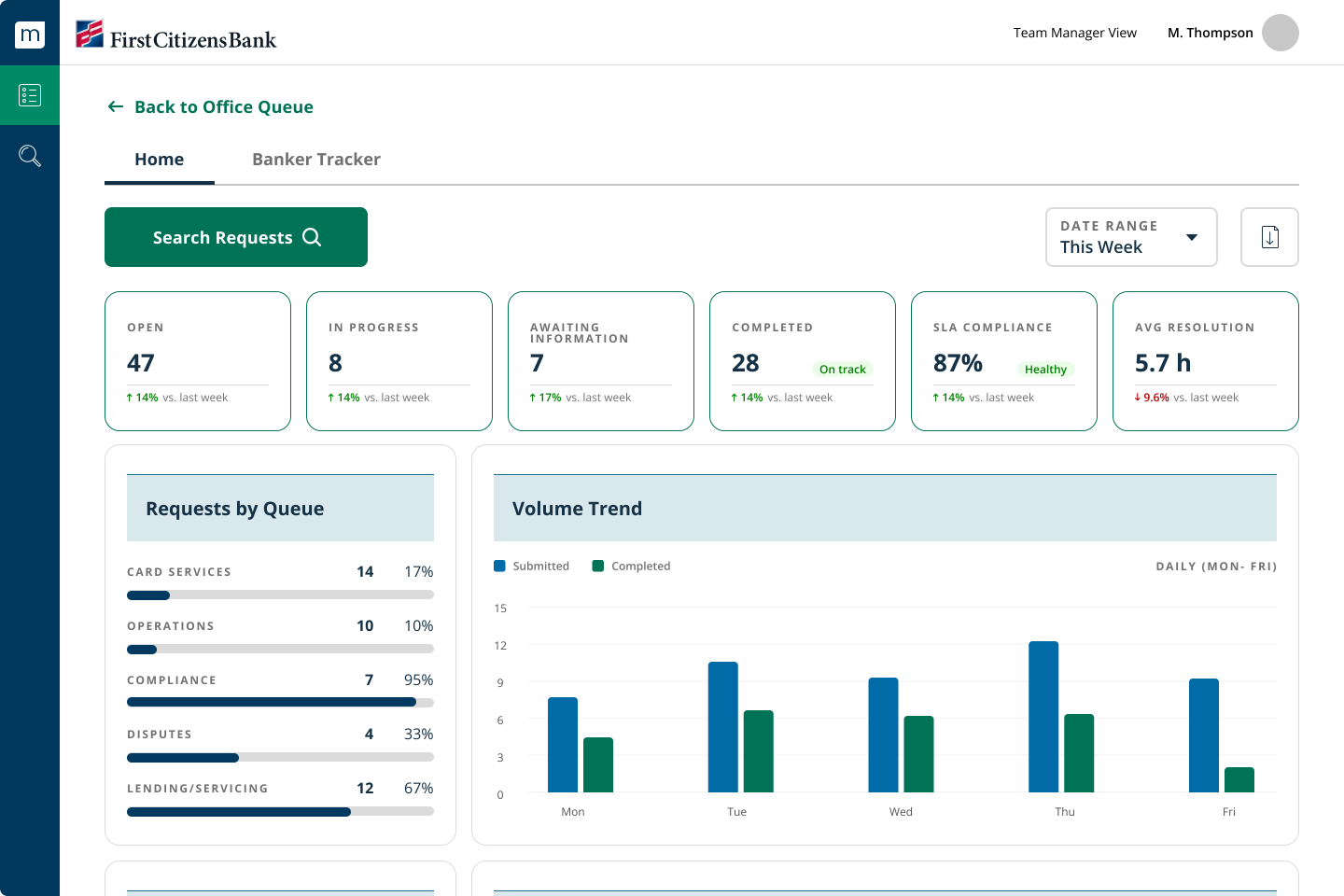
Course-Correcting with Research

The requirements behind those designs were based on assumptions and outdated information, never constructed around how PCS and SS associates actually manage requests day-to-day. With Mosaic headed toward an MVP release impacting hundreds of associates, we needed to speak directky to the users to ensure that we are solving for their needs.
Method
I conducted six interviews with associates across both roles, three in Premier Client Services and three in Shared Services, to understand how request management actually works day-to-day. The majority of each interview focused on role clarification, workflow discovery, and current task needs, with a smaller segment dedicated to direct feedback on the initial dashboard designs.
Research Goal


With research complete, the next step was translating six interviews’ worth of findings into something actionable — not just insights for the record, but direct recommendations for both my team and leadership on how the dashboards needed to change. I built a slide deck to present these findings and frame three clear recommendations

With my recommendations presented, my direct involvement in the request management dashboards came to a close. From there, the work was handed off to a fellow designer, who incorporated these recommendations directly into the final designs. Because that work continued after my internship ended, I’m unable to show the finished screens here — but the base of knowledge had been established.
1
Split-screen view to manage uploads and form
2
Simple CHW interaction to confirm or edit autofilled information
3
Status signifiers to guide process, aided by tooltip
4
Complete confirmation enforced prior to submission
Faster request completion through reduced re-entry and clearer status visibility
Improved SLA compliance — the one metric both PCS and Shared Services agreed mattered most
Fewer manual status check-ins, freeing associates to spend more time on active requests
The interviews surfaced broader patterns — platform fragmentation, a shared emphasis on SLA compliance, and role-specific ways of prioritizing work — that extend well past this one dashboard. At MVP release in late 2026, these findings are positioned to impact hundreds of associates across both Premier Client Services and Shared Services, and to inform feature development on Mosaic going forward.
Reflections
Designing from validated areas of need
Coming into the product at a mid-point, I learned first-hand the importance of dedicated discovery prior to feature development. Bringing forward a tool based on limited end-user conversations provides no value to the associates using it in their day-to-day. Taking the time to conduct these interviews allowed me to contribute foundational knowledge about these respective roles and ensure we were building around the needs of the user.
Planning for divergence, not just singular perspectives
Going in, it would have been easy to treat PCS and Shared Services as one user type sharing a workflow. Research proved otherwise — they’re measured differently and prioritize different information to complete their daily tasks. Designing a system of dashboards across both roles meant the real work was understanding exactly where they diverged and how to best provide for the various interactions needed to complete a request from end-to-end.